
San Joaquin Valley Democratic Club P.O. Box 28095 Fresno, CA 93729
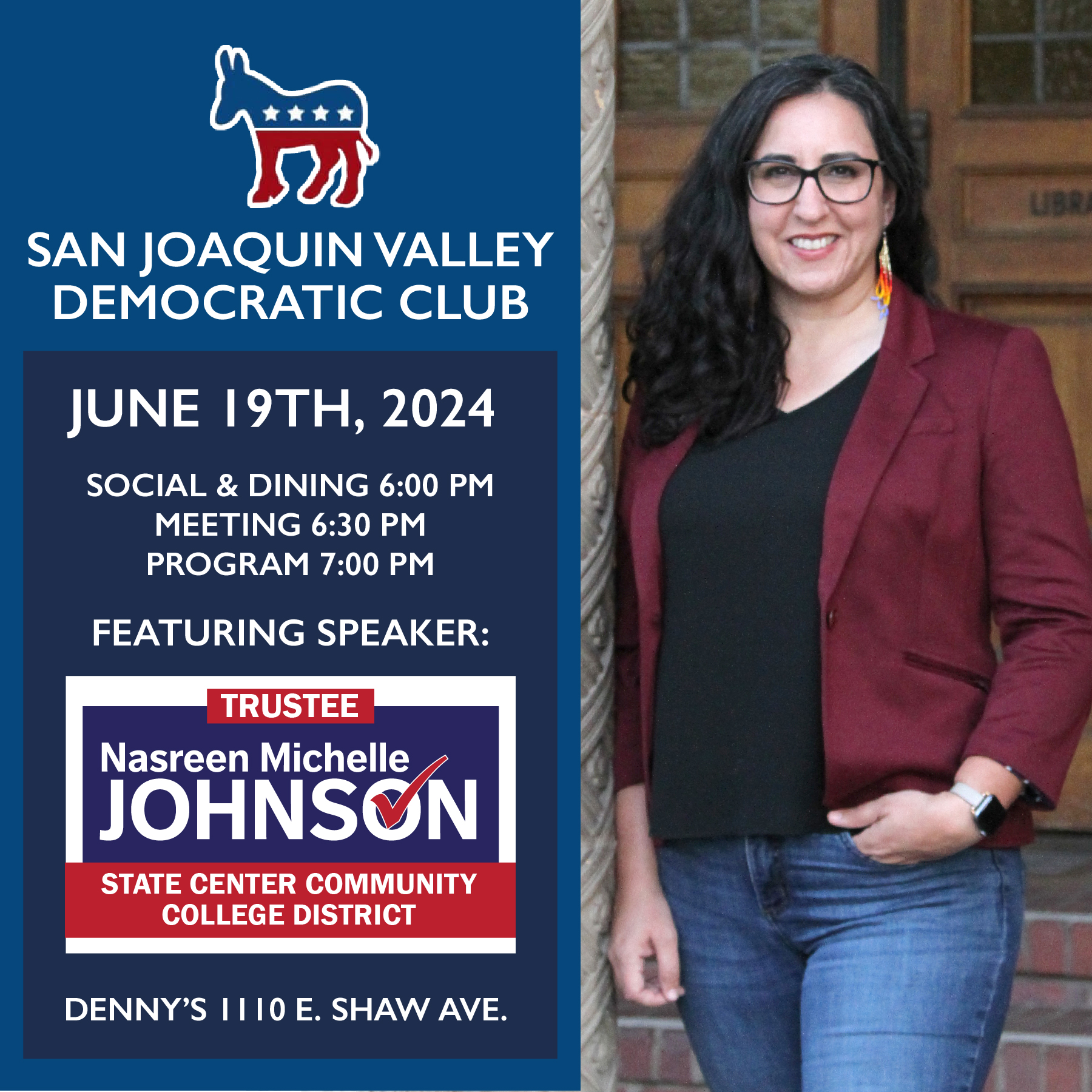
Meetings are on: Third Wednesday of every month Denny's 1110 E. Shaw Ave. 6:30 - 9:00 pm
Board Members
President James Williams
Vice President Susana Guevara
Secretary
Faun Horton
Treasurer Jason Carns
Communications Chuck Krugman
Welcome
Welcome to the San Joaquin Valley Democratic Club!
The San Joaquin Valley Democratic Club is a local Democratic club serving Fresno County and surrounding areas. We are a club that is dedicated to social justice and basic human rights for all. We belive that grassroots organizing, neighbor talking to neighbor, is essential to spreading the message of the Democratic party and the San Joaquin Valley Democratic club. Our members are encouraged to be active in the community with voter registration, precinct walking, tabling and phone banking.
California Senate Distirct maps
Jan 29-
Once again the Republicans have out done themselves, or did it to themselves. Do you remember several years ago they insisted on a Citizens Redistricting Commission to come up with the political districts here in California? There could only be people that really did not pay attention to politics on the commission, just medium to high propensity voters.
They got what they wanted, no more smoke filled back room deals. No more favors, just what is good, true and just for the California that they love and cherish. The commission was made of 5 Democrats, 5 Republicans and 4 people who are third party or decline to state in registration. If it was reflective of Californias registration it would have been more like 7 Democrats, 4 Repuplicans and 3 others, but that is a whole different issue.
This is where it gets messy so pay attention. California is one of only a few states, that requires a 2/3 vote to pass buget and revenue items in the state legislator. This is a Prop 13 issue from the '70s that we have been dealing with for over 30 years now. It has resulted in late budgets, accounting gimmicks, massive cuts to the safety net etc.... Republicans currently are able to stop anything that deals with money because of 2 Senate and 2 Assembly seats, they hold any power in Sacramento becuase of this 2/3 vote, or those 4 seats. The redistiricting commission just wiped that out in the Senate, and the Republicans are pissed. So what did they do, they started on the process of gathering the needed signatures to overturn the results of one of thier ideas that they were willing to hold the state hostage over. And I know for a fact they tried everything they could to get Republican operatives onto the redistricting commission but failed. Look at the applications that were challenged and ultimately rejected and you too will see they were up to no good.
To make a long story short, all this Republican waste of time and taxpayer money, to overturn one of their own ideas that they wanted in place to screw the state of California even more, has been rejected by the California Supreme Court. Read the decision here The Senate maps as drawn will stand, regarless of the Republican sniveling that is happening.
So lets get out there, win those Senate seats and let the Republicans live with their sins.
Kudos to Wisconsin
Jan 17-
The state of Wisconsin has turned in one million recall petions against Republican Governor Scott Walker. He came into office just over a year ago in that red tide that swept the county. Now that he has a political record, flown his true colors he is being recalled.
The Republican Lt. Governor of Wisconsin had 845,000 signatures turned in, enough for a recall effort.
4 Republican Senators also had enough signatures turned in to force a recall election against them. One seat pickup in that chamber will turn control back over to the Democratic party there.
The Republican party has out done itself again. They currently have a case working its way through the courts that states banning corporate contributions in politics is unconstitutional. Read the amicus here.
Yes, when Mitt Romney said "corporations are people my friend" at a campaign stop in Iowa this year he was not kidding. When Citizens United passed the Supreme Court we were in for a lot of trouble. If this passes we will be bought and paid for by Exxon. All the best politicians that money can buy.
Way to go San Joaquin Valley Democratic club, we have been recognized by the state party for our efforts to turn the county to a brighter blue. A big thank you to all who have come out to help us and who will be coming out to help us. This is not a one person job, it is and always will be a team effort.
Once again, thank you for your time and effort on this very important work.
An open letter to California from Gov. Brown
Dec 5-
When I became Governor again -- 28 years after my last term ended in 1983 -- California was facing a $26.6 billion budget deficit. It was the result of years of failing to match spending with tax revenues as budget gimmicks instead of honest budgeting became the norm.
In January, I proposed a budget that combined deep cuts with a temporary extension of some existing taxes. It was a balanced approach that would have finally closed our budget gap.
I asked the legislature to enact this plan and to allow you, the people of California, to vote on it. I believed that you had the right to weigh in on this important choice: should we decently fund our schools or lower our taxes? I don’t know how you would have voted, but we will never know. The Republicans refused to provide the four votes needed to put this measure on the ballot.
Forced to act alone, Democrats went ahead and enacted massive cuts and the first honest on-time budget in a decade. But without the tax extensions, it was simply not possible to eliminate the state’s structural deficit.
The good news is that our financial condition is much better than a year ago. We cut the ongoing budget deficit by more than half, reduced the state’s workforce by about 5500 positions and cut unnecessary expenses like cell phones and state cars. We actually cut state expenses by over $10 billion. Spending is now at levels not seen since the seventies. Our state’s credit rating has moved from “negative” to “stable,” laying the foundation for job creation and a stronger economic recovery.
Unfortunately, the deep cuts we made came at a huge cost. Schools have been hurt and state funding for our universities has been reduced by 25%. Support for the elderly and the disabled has fallen to where it was in 1983. Our courts suffered debilitating reductions.
The stark truth is that without new tax revenues, we will have no other choice but to make deeper and more damaging cuts to schools, universities, public safety and our courts.
That is why I am filing today an initiative with the Attorney General’s office that would generate nearly $7 billion in dedicated funding to protect education and public safety. I am going directly to the voters because I don’t want to get bogged down in partisan gridlock as happened this year. The stakes are too high.
My proposal is straightforward and fair. It proposes a temporary tax increase on the wealthy, a modest and temporary increase in the sales tax, and guarantees that the new revenues be spent only on education. Here are the details:
Millionaires and high-income earners will pay up to 2% higher income taxes for five years. No family making less than $500,000 a year will see their income taxes rise. In fact, fewer than 2% of California taxpayers will be affected by this increase.
There will be a temporary ½ cent increase in the sales tax. Even with this temporary increase, sales taxes will still be lower than what they were less than six months ago.
This initiative dedicates funding only to education and public safety--not on other programs that we simply cannot afford.
This initiative will not solve all of our fiscal problems. But it will stop further cuts to education and public safety.
I ask you to join with me to get our state back on track.
UC Davis
Nov 24- Here is the video of an abusive police force that has not been held accountable to this point, sounds a lot like Fresno but it was at UC Davis.
The long walk of shame for the UC Davis Chancellor because she wants to stall any investigation of the campus police for 30 days. To her credit, she did move that decision from 90 to 30 days.
Blue Shield admits to overcharging California customers by about half a billion since 2010
Oct 16- It is a masterful spin by the self-described not-for-profit Blue Shield of California to announce that it is returning all but two percent of its profits to its customers, as though this were some act of humble generosity. It’s a little like a supermarket announcing that from now on it’s going to give back (almost) all of your change. (It’s actually worse than that, as I’ll explain.)
All told, Blue Shield will have returned about $475 million in profits - $283 million that Blue Shield is crediting back in December plus about $167 million credited back earlier in the year for 2010 premiums as well as the $25 million the company distributed to doctors, hospitals and an as yet unnamed “community investment.” But this should not be thought of as a sincere gift from a community-oriented nonprofit. Rather, it’s nearly half a billion dollars that Blue Shield overcharged its policyholders and then held onto for months.
What’s more, the $283 million that will go to reducing policyholders’ December premium payments is utter chump change when given a full context:Blue Shield, according to documents it files with the state of California, has more than $3 billion in excess surplus (“Tangible Net Equity excess” is the formal term). That massive and ever growing pot of money is a profit account that Blue Shield uses to take policyholder premium out of the healthcare system so they can come back and charge those same policyholders high rates again next year. Blue Shield could give back $280 million a month for an entire year and still have a enough money on hand to run a stable insurance company. Or, to think of it a little differently, instead of giving families back a few hundred dollars for Christmas, they could just sell insurance at a reasonable premium and not stuff their own stockings with surplus.
To be sure, Blue Shield is angling for a feel good story it can tell politicians and voters when they next consider whether to enact a law or initiative regulating the premiums health insurance companies can charge. That story may work with some politicians in Sacramento, but I doubt voters who are stuck overpaying for health insurance will be so easily spun.
Doug Heller
Doug Heller is the Executive Director of Consumer Watchdog. Visit our website at: www.ConsumerWatchdog.org.
The Occupy Wall Street protests are shining a national spotlight on the most powerful, dangerous, and secretive economic and political force in America.
If this country is to break out of the horrendous recession and create the millions of jobs we desperately need, if we are going to create a modicum of financial stability for the future, there is no question but that the American people are going to have to take a very hard look at Wall Street and demand fundamental reforms. I hope these protests are the beginning of that process.
Let us never forget that as a result of the greed, recklessness, and illegal behavior on Wall Street, this country was plunged into the worst economic downturn since the Great Depression. Millions of Americans lost their jobs, homes, and life savings as the middle class underwent an unprecedented collapse. Sadly, despite all the suffering caused by Wall Street, there is no reason to believe that the major financial institutions have changed their ways, or that future financial disasters and bailouts will not happen again.
More than three years ago, Congress rewarded Wall Street with the biggest taxpayer bailout in the history of the world. Simultaneously but unknown to the American people at the time, the Federal Reserve provided an even larger bailout. The details of what the Fed did were kept secret until a provision in the Dodd-Frank Act that I sponsored required the Government Accountability Office to audit the Fed’s lending programs during the financial crisis.
As a result of this audit, the American people have learned that the Federal Reserve provided more than $16 trillion in low-interest loans to every major financial institution in this country, huge foreign banks, multi-national corporations, and some of the wealthiest people in the world.
In other words, when Wall Street was on the verge of collapse, the federal government acted boldly, aggressively, and with a fierce sense of urgency to save our financial system from collapse with no strings attached.
Now that the middle class is collapsing and a record-breaking 46 million Americans are living in poverty, the Federal Reserve has failed to act with the same sense of urgency to make sure that small businesses receive the affordable loans needed to put millions of Americans back to work and prevent millions of Americans from losing their homes.
As a result, Wall Street is back to making record-breaking profits, handing out record-breaking compensation packages, and taking the same risks that caused the financial crisis in the first place. Meanwhile, 25 million Americans are unemployed or under-employed; middle class families are making $3,600 less than they did ten years ago; the foreclosure rate is still breaking new records; and the American people are still paying over $3.40 for a gallon of gas.
The financial crisis and the jobs crisis have demonstrated to the American people that we now have a government that is of the 1 percent, by the 1 percent and for the 1 percent, as Nobel Prize winning economist Joseph Stiglitz eloquently articulated. The rest of the 99 percent are, more or less, on their own. We now have the most unequal distribution of wealth and income of any major, advanced country on earth. The top one percent earn more income than the bottom 50 percent and the richest 400 Americans own more wealth than the bottom 150 million Americans.
Now that Occupy Wall Street is shining a spot light against Wall Street greed and the enormous inequalities that exist in America, the question then becomes, how do we change the political, economic and financial system to work for all Americans, not just the top 1 percent?
Here are several proposals that I am working on:
1) If a financial institution is too big to fail, it is too big to exist. Today, the six largest financial institutions have assets equal to more than 60 percent of GDP. The four largest banks in this country issue two-thirds of all credit cards, half of all mortgages, and hold nearly 40 percent of all bank deposits. Incredibly, after we bailed out these big banks because they were "too big to fail," three out of the four largest are now even bigger than they were before the financial crisis began. It is time to take a page from Teddy Roosevelt and break up these behemoths so that their failure will no longer lead to economic catastrophe and to create competition in our financial system.
2) Put a cap on credit card interest rates to end usury. Today, more than a quarter of all credit card holders in this country are paying interest rates above 20 percent and as high as 59 percent. When credit card companies charge 25 or 30 percent interest rates they are not engaged in the business of “making credit available” to their customers. They are involved in extortion and loan-sharking. Citigroup, Bank of America, and JP Morgan Chase should not be permitted to charge consumers 25-30 percent interest on their credit cards, especially while these banks received over $4 trillion in loans from the Federal Reserve.
3) The Federal Reserve needs to provide small businesses in America with the same low-interest loans it gave to foreign banks. During the financial crisis, the Federal Reserve provided hundreds of billions of dollars to foreign banks and corporations including the Arab Banking Corporation, Toyota, Mitsubishi, the Korea Development Bank, and the state-owned Bank of Bavaria. At a time when small businesses can't get the lending they need, it is time for the Fed to create millions of American jobs by providing low-interest loans directly to small businesses.
4) Stop Wall Street oil speculators from artificially increasing gasoline and heating oil prices. Right now, the American people are being gouged at the gas pump by speculators on Wall Street who are buying and selling billions of barrels of oil in the energy futures market with no intention of using a drop for any purpose other than to make a quick buck. Delta Airlines, Exxon Mobil, the American Trucking Association, and other energy experts have estimated that excessive oil speculation is driving up oil prices by as much as 40 percent. We have got to end excessive oil speculation and bring needed relief to American consumers.
5) Demand that Wall Street invest in the job-creating productive economy, instead of gambling on worthless derivatives. The American people have got to make it crystal clear to Wall Street that the era of excessive speculation is over. The “heads, bankers win; tails, everyone else loses” financial system must end. Most important, we need to create a new Wall Street that exists not to reward CEOs and investors for the bets they make on exotic financial instruments nobody understands. Rather, we need a Wall Street that provides financial services to small businesses and manufacturers to create decent-paying jobs and grow the economy by productive means. Think of all of the productive short- and long-term investments that could be made in our country right now if Wall Street used the money it has received from the federal government wisely. Instead of casino-style speculation, Wall Street could invest in high-speed trains; fuel-efficient cars; wind turbines and other alternative energy sources; affordable housing; affordable prescription drugs that save people’s lives; and other things that America desperately needs. That is what we have got to demand from Wall Street.
6) Establish a Wall Street speculation fee on credit default swaps, derivatives, stock options and futures. Both the economic crisis and the deficit crisis are a direct result of the greed and recklessness on Wall Street. Establishing a speculation fee would reduce gambling on Wall Street, encourage the financial sector to invest in the productive economy, and significantly reduce the deficit without harming average Americans. There are a number of precedents for this. The U.S had a similar Wall Street speculation fee from 1914 to 1966. The Revenue Act of 1914 levied a 0.2 percent tax on all sales or transfers of stock. In 1932, Congress more than doubled that tax to help finance the government during the Great Depression. And today, England has a financial transaction tax of 0.25 percent, a penny on every $4 invested.
Making these reforms will not be easy. After all, Wall Street is clearly the most powerful lobbying force on Capitol Hill. From 1998 through 2008, the financial sector spent over $5 billion in lobbying and campaign contributions to deregulate Wall Street. More recently, they spent hundreds of millions more to make the Dodd-Frank bill as weak as possible, and after its passage, hundreds of millions more to roll back or diluter the stronger provisions in that legislation.
"These funds shall not be used to supplant existing state or county funds utilized to provide mental health services." That phrase is from Section 5891(a) of the Mental Health Services Act of 2004, also known as Proposition 63.
The proposition was passed to provide increased funding, personnel and other resources to support county mental health programs, and I remember the hope that we in the health-care industry had that greater community health and safety would soon be realized.
I also remember 2007, when the Los Angeles Times reported, "Fresno County will use its $8.6 million in Proposition 63 funds to provide exhaustive care to 540 severely ill residents and for rural outreach, among other programs. But the county is simultaneously cutting about $8 million from the rest of its mental health budget."
This was devastating news, and the resulting and increasing reduction of services and medication for the mentally ill in Fresno County in the ensuing years has been difficult to watch. What was not apparent at the time was that we were witnessing the opening salvo in a war on community health that has been waged ever since.
No aspect or avenue in Fresno has escaped impact. Are you concerned about crime and violence in your neighborhood? Public safety is a factor of community health.
Study after study shows that untreated mental illness leads to preventable violence and crime, and locks the mentally ill into a legal process they may not have the resources to navigate.
Are you concerned about the number of homeless in Fresno? Homelessness is a factor of community health. A city can provide homes sufficient to house every single homeless individual. But if mental health services are not sufficient to the need, housing resources will be neglected or ignored.
Are you anxious for business development to pick up, and for jobs to be created? Business development is a factor of community health. In my own office complex near Fig Garden, I was approached by two individuals. They were professionals, seeking to open up an office. Their comment to me: they were walking through office complexes to see how many shopping carts (i.e., homeless) there were.
The issue of community health is not specific to mental health. In recent weeks, we have seen the rejection of support for a needle exchange program. This decision flies in the face of established community health policy and research.
A study by the National Institutes of Health found that exchange programs "show a reduction in risk behaviors as high as 80% in injecting drug users." Exchange program participants have been found five times more likely to enter drug treatment than those who had never used an exchange, and exchange programs unquestionably reduce the spread of communicable diseases in a community.
Most recently, a decision was made to forego up to $56 million in federal community health funds through 2013, a decision that was defended as being financially responsible. But Kathleen Grassi, Fresno County assistant health director, said the county will experience a greater degree of difficulty trying to sign up uninsured residents when the new health-care law expands coverage. Those that remain uncovered and untreated create a potential cost to the community that negates all savings anticipated by opting out of the federal funding.
Community health, whether through preventative services or immediate access and care, drives community safety. Community safety and security drive the decisions of business owners and entrepreneurs in where and when to establish job-creating enterprises. And expanding business development lends itself to community prosperity through jobs, and through an expanded tax base to provide funding for ... you guessed it, community health.
The concepts of community health, public safety and business development can no longer be bullet points or items listed in terms of priority. They are circular aspects of Fresno and Fresno County that are inextricably linked and that must be viewed as one interconnected Fresno concern.
Debbie Harkness Fresno
This was reprinted with permission from the author.
The Party structure
Sept 11-
Have you ever wondered how the Democratic party in California is organized? If you do then you are like a lot of people. Here is a video that explains how all the parts fit together and may help you decide where you best fit in to it all.
Paid for by the California Democratic Council 8124 West 3rd Street - Suite 207 - Los Angeles, CA 90048 Not authorized by any candidate or candidate committee.